
Find Deed Records in Boston
Boston deed records are held by the Suffolk County Registry of Deeds, which covers all 20 of the city's neighborhoods. Whether you need to confirm current ownership, trace a chain of title, or pull a copy of a recorded document, this page walks you through how to search deed records online and in person, what you can find, and where else to look when the main registry doesn't have what you need.
Boston Overview
Suffolk County Registry of Deeds
All Boston deed records are filed with the Suffolk County Registry of Deeds. The office is at 24 New Chardon Street, Boston, MA 02114, and can be reached by phone at (617) 788-6221. Register of Deeds Anne Merry Donoghue runs the office. General hours are Monday through Friday, 8:30 AM to 4:00 PM. If you need to record a document in person, the recording window is open from 9:00 AM to 3:00 PM on those same days. The registry handles deeds, mortgages, discharges, homestead declarations, liens, and a range of other real property documents for the entire city of Boston.
Because Boston grew over time by annexing many surrounding towns, older deeds may be filed under a former town name. If you are researching property in neighborhoods like Roxbury, Dorchester, Brighton, or West Roxbury, keep in mind that those areas were once separate municipalities. Records created before annexation may be indexed under the original town name. Staff at the registry can help you find the right search terms when you run into this. It is a common issue for Boston title research, and the staff are used to it. Don't assume a gap in the chain of title means a document is missing. It may just be filed under the old neighborhood's pre-annexation name.
Search Boston Deed Records Online
The fastest way to find Boston deed records is through Massachusetts Land Records for Suffolk County. This free public portal lets you search by grantor name, grantee name, or property address. You can view document images and download copies at no charge. The online system holds records going back to 1627, which makes it one of the deepest digital deed archives in the country. Land Court documents, which cover registered land in Boston, are available through the same portal starting from 1899.
When you search, you will see two types of land in Massachusetts: recorded land and registered land. Most Boston properties use recorded land, where each transaction gets a new deed filed in the registry. Registered land works differently. A certificate of title is issued and updated each time the property changes hands, rather than stacking up new deeds over time. If your search comes up empty for a property you know has been sold, it may be on the registered land side. The masslandrecords.com portal covers both, but you need to search each system separately. This is a common source of confusion for first-time researchers, so it is worth knowing before you start.
Searches on masslandrecords.com are free. Certified copies cost more if you need them for legal or official use, but you can view and print documents for personal research at no cost through the site.
Boston Assessing Department
Before you dig into the registry, it often helps to start with the Boston Assessing Department. Their online tools let you look up a property by street address and pull the current assessed value, owner name, and parcel ID. That owner name and parcel ID can then anchor your registry search and save you time.
Visit the Boston Assessing Department website to look up a parcel by address before heading to the registry.
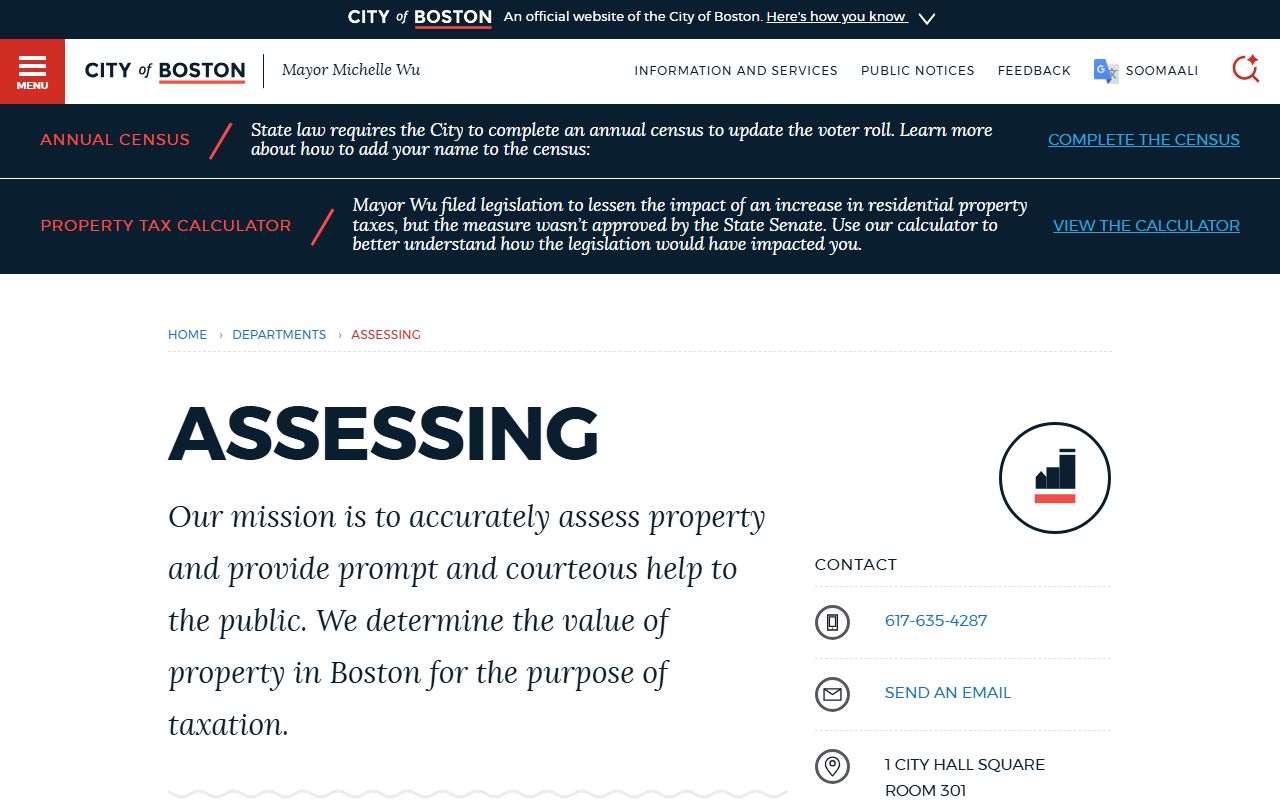
The screenshot above shows the Boston Assessing Department's online portal, where you can find current ownership and parcel data to guide your deed search at masslandrecords.com.
The Assessing Department is at 1 City Hall Square, Room 301, Boston, MA 02201, phone (617) 635-4237. Their site is free to use and needs no account. Once you have the owner's name from the assessor, plug it into masslandrecords.com as the grantee to find when they bought the property, and as the grantor to see if they have sold anything else in the county. This two-step approach is faster than starting cold with the registry search alone, especially on properties with common street addresses or owner names.
Recording Fees and Transfer Tax
The Suffolk County Registry of Deeds charges set fees to record documents. A standard deed costs $155. A mortgage costs $205. A discharge of mortgage runs $105, and a homestead declaration is $35. These fees apply per document, and each additional page beyond the first may add a small charge. If you are recording several documents as part of one transaction, each one gets its own fee.
Massachusetts also charges an excise tax on real estate transfers. The rate is $4.56 per $1,000 of the sale price, with the price rounded to the nearest $500. On a $500,000 home sale, the excise tax comes to $2,280. This tax is paid at the time of recording and must be included with the deed. The recording staff can calculate the amount if you are not sure. The legal framework for deed recording in Massachusetts is set out in Massachusetts General Laws Chapter 183, which covers how documents must be prepared and recorded to be valid.
How to Research a Boston Property
Start at the Boston Assessing Department website. Enter the street address and get the current owner name and parcel ID. Write both down. Then go to masslandrecords.com/suffolk/ and search the owner's name as both grantor and grantee. The most recent deed will show the seller, the buyer, the sale date, and the legal description of the property.
To build a chain of title, work backward from the most recent deed. The grantor on the current deed was the prior owner. Search that name as a grantee to find when they bought the property and who sold it to them. Keep going back until you have the chain you need. For most purposes, going back 50 years is enough, but the online records reach to 1627 if you need to go further. Pre-1975 deeds are on masslandrecords.com for Suffolk County, but some very old records may be clearer to read in person at the registry or through the Massachusetts State Archives. If you hit a wall with a neighborhood that was once its own town, check the annexation date and search under the old town name for records before that year. The Boston City Archives at 201 Rivermoor Street, West Roxbury, MA 02132, (617) 635-1195, archives@boston.gov, can fill gaps with historical tax records, city directories from 1838 to the present, maps, photographs, and building permits. Their site is at boston.gov/departments/archives-and-records-management.
Deed Fraud Alerts
The Massachusetts Land Records system offers a free deed fraud alert service called the Consumer Notification Service. Sign up at cns.masslandrecords.com and you will get an email alert any time a document is recorded in Suffolk County that includes your name. The service is free and needs no paid account.
Deed fraud is a real issue in large cities. Someone who files a forged deed in your name can create title complications that take significant time and legal work to fix. The notification service gives you a heads-up so you can act fast if something looks wrong. It is a simple step that takes only a few minutes to set up.
Historical Records and Genealogical Research
Boston has some of the oldest property records in the country. The online system goes back to 1627, but for deep genealogical or historical title research, a few other sources can help. The Boston Public Library holds local history collections that include maps, atlases, and records that can help you locate properties before street addresses were standardized. The Massachusetts Historical Society has manuscripts and collections that touch on early land grants and transfers.
The New England Historic Genealogical Society (NEHGS) holds an extensive deed microfilm collection for Suffolk County. If you are doing genealogical research and need records from periods that predate easy online access, NEHGS is worth a look. Their collections overlap with what is at the registry but sometimes offer better indexing for older materials. Membership is needed for full access, but some resources are open to the public. Together, these sources, the registry portal, the assessor, the city archives, the public library, and NEHGS, give you a strong set of tools for Boston property research at any depth you need.
Suffolk County Deed Records
Boston deed records are part of the Suffolk County system. All documents recorded in Boston go through the Suffolk County Registry of Deeds, which serves the entire city.