
Search Massachusetts Deed Records
Massachusetts deed records are public documents that show property ownership, land transfers, mortgages, liens, and easements recorded across the state. They are kept by 21 Registry of Deeds districts spread across 14 counties. You can search deed records for free at the state land records portal, or visit your local registry to get certified copies of recorded documents. This guide covers how the system works, where to search, and what to expect when you need property records in Massachusetts.
Massachusetts Deed Records at a Glance
How to Search Deed Records in Massachusetts
The main tool for finding Massachusetts deed records is masslandrecords.com, the official statewide land records portal run by the Secretary of the Commonwealth. This free site gives access to deeds, mortgages, mortgage discharges, easements, liens, and plans from all 21 registry districts across the state. No account is needed to view documents. You pick a registry from a dropdown menu, choose a search type, and enter what you know. Results appear quickly and link directly to document images.
Several search methods are available on the portal. Name search is the most common starting point. You enter a last name first, then narrow by first name, town, document type, or date range. The system checks both grantor and grantee indexes, which are the seller and buyer sides of any property transaction. Property address search works for most records from the late 1990s onward, but many older filings have no address data attached. Book and page search lets you pull a specific document when you already have that reference. Recorded date search returns all documents filed within a date window, which is useful for title work and research projects.
Search results show the document number, type, recorded date and time, book and page number, number of pages, the recording fee paid, and the names of all parties. Clicking through to a result opens the document image. For registered land, also called Land Court records, searches use certificate of title numbers rather than book and page. If a property does not appear in the recorded land search, try switching to the registered land option in the search interface.
A few things can trip up a search. Pre-1995 records often carry no property address. Liens are indexed by owner name, not by address. Hyphenated street numbers may not match if you search only part of the number. When a search comes up empty, try alternate name spellings or a broader date range. Pre-1976 grantor and grantee indexes are available as scanned pages, but they are not linked to document images the way newer records are. Use book and page search to pull older documents once you find the right reference in the scanned index.
Massachusetts Land Records Portal
The Massachusetts Land Records portal connects all 21 registry districts and is managed by the Secretary of the Commonwealth's office. Each district has an elected Register of Deeds who oversees recording and public access. When you view a deed on the portal, the electronic cover sheet shows the document number, type, recorded date and time, book and page, number of pages, receipt number, the recording fee, and any excise tax paid. Below the cover sheet is the actual deed image, which shows the grantor and grantee names, the legal description of the property, the consideration amount, notary acknowledgments, and the registry stamp.
Records go back centuries at many registries. Middlesex North and Suffolk County have records from 1629 available online at no cost. Plymouth County holds Plymouth Colony deeds from the 1620s. Hampshire County records start in 1662. For most registries, indexed name searches go back to the 1960s or 1970s, with older documents available through book and page lookup. The portal also includes a plans search for subdivision plans, condominium plans, and easement plans by book, page, or town. The Massachusetts Interactive Property Map is a companion tool that lets you locate a parcel by address before doing a deed search.
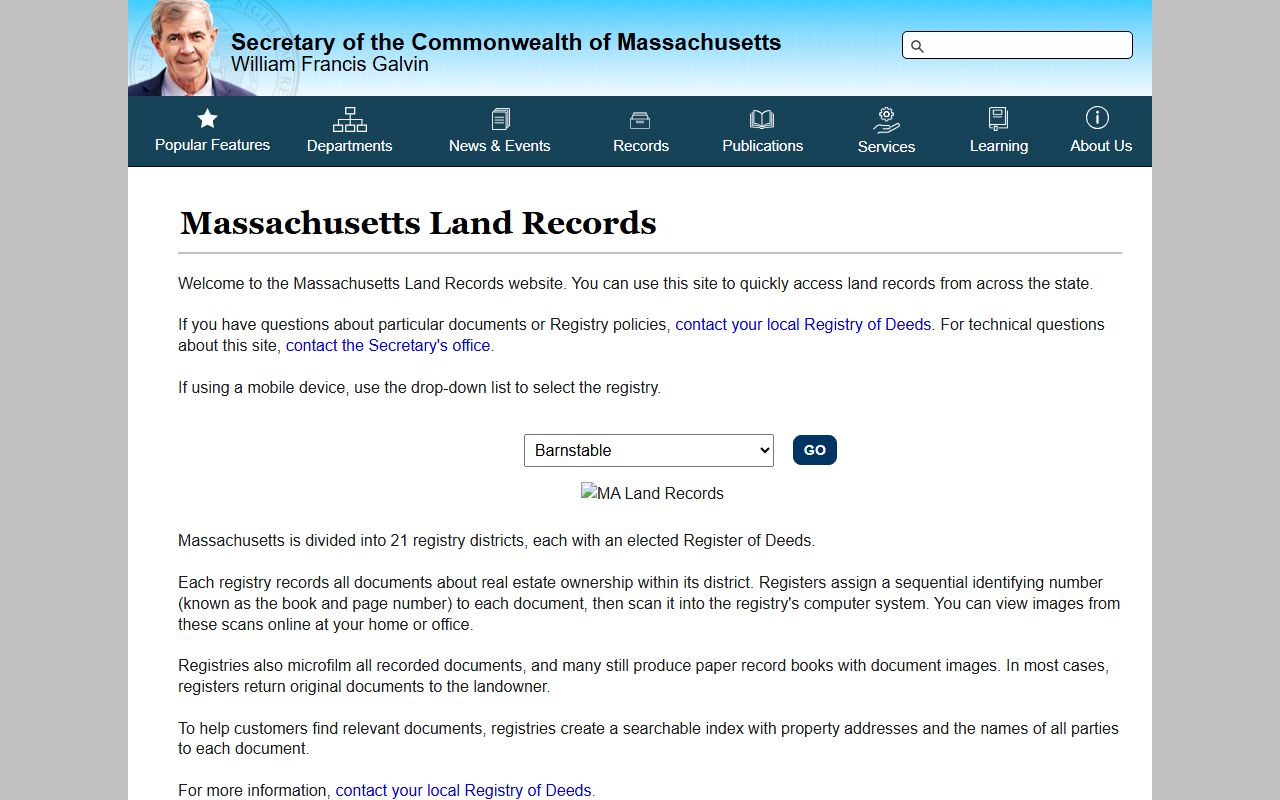
The Massachusetts Land Records portal at masslandrecords.com is the free starting point for any deed record search across all 21 registry districts.
Recording Deed Documents in Massachusetts
Massachusetts has specific rules for how deed documents must be prepared before they can be recorded. Under MGL Chapter 36, Section 12A, paper must be white, at least 20-pound weight, and printed on one side only. Paper size must be between 8.5 by 11 inches and 8.5 by 14 inches. Font must be at least 10-point type. The first page must have a clear 3-inch area in the upper right corner and a clear 3-inch strip along the top so the registry can stamp the recording data without covering any text on the document.
Under MGL Chapter 183, Section 29, no deed can be recorded without a proper certificate of acknowledgment. At least one grantor must sign the deed before a notary public. The notary must sign, print their name clearly, and include their commission expiration date. A missing notary seal does not automatically prevent recording as long as the signature and expiration date are present. The deed must also carry "prepared by" and "return to" statements on the first page. For deeds, mortgages, and discharges, the property address must appear in the left margin. Social security numbers cannot appear anywhere on the document. Highlighting is not permitted. Exhibits go at the end of the document. Names must be printed under all signatures.
Once all requirements are met, the deed goes to the registry in the county where the property sits. The first-to-record rule applies under MGL Chapter 183, Section 4: recording gives public notice of ownership, and the first party to record has priority over later claimants. The registry assigns a sequential book and page number, and that reference becomes the permanent identifier for the document.
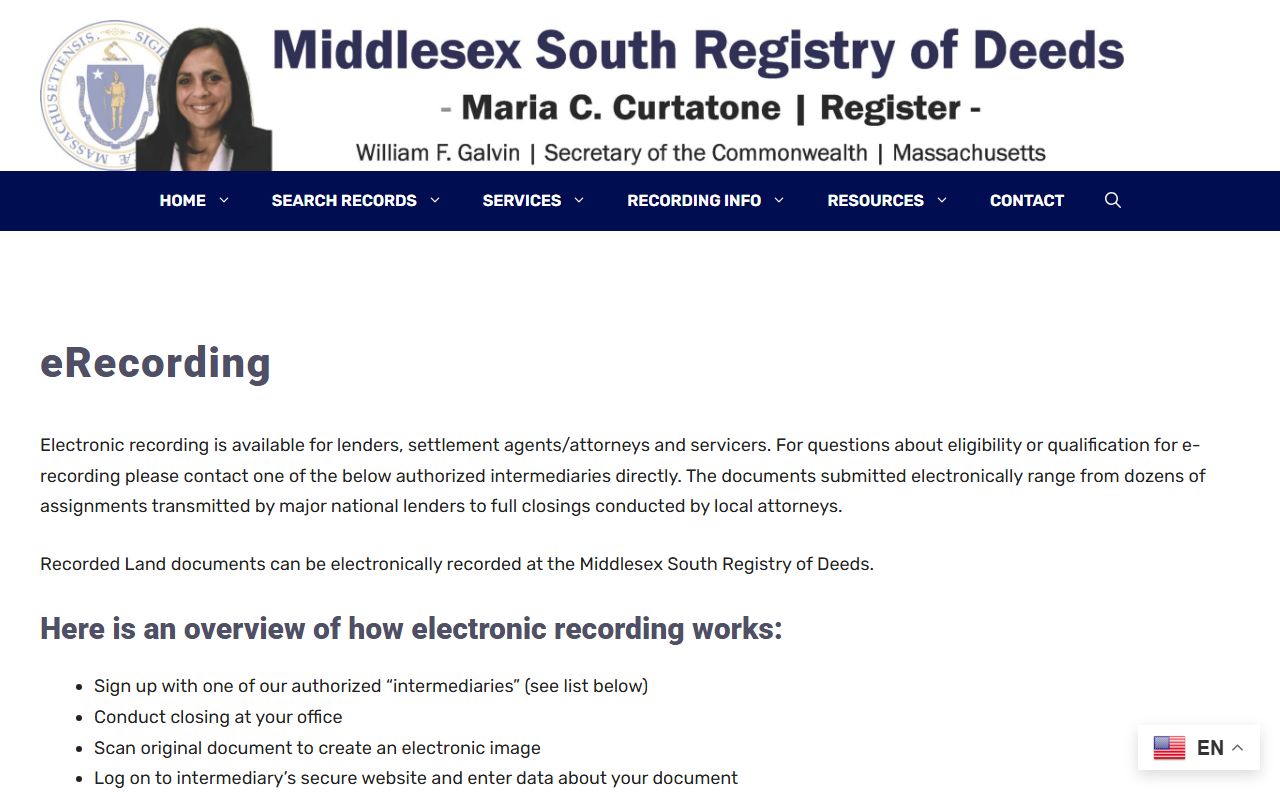
Electronic recording is available at most Massachusetts registries through approved vendors including Simplifile, CSC, and Xerox eRecording. The Middlesex South e-recording guide walks through the full process from document upload to electronic payment.
Massachusetts Deed Recording Fees
Recording fees are set statewide and apply at all 21 Massachusetts registries. The current schedule took effect December 31, 2019. A standard deed costs $155 to record. A mortgage costs $205. Mortgage discharges, releases, and partial releases cost $105. A Declaration of Homestead costs $35. Plans cost $105 per sheet. Federal tax liens cost $5. All other standard documents cost $105. Copies are $1 per page, whether plain or certified. Some registries, like Bristol Fall River, charge $0.50 per page for standard copies and $1.00 for certified copies.
On top of the recording fee, most deed transfers require payment of the Massachusetts excise tax. The rate is $4.56 per $1,000 of consideration, rounded up to the nearest $500. A home that sells for $500,000 carries an excise of $2,280. A sale at $500,100 rounds up to $500,500 and the tax becomes $2,282.28. Transfers under $100 consideration are exempt. Use the free excise tax calculator at Franklin County Deeds to get the exact figure for any sale price before you go to the registry. At most registries, excise tax requires a separate check from the recording fee. Cash and attorney checks are the standard payment methods, though electronic funds transfers are used for e-recorded documents.
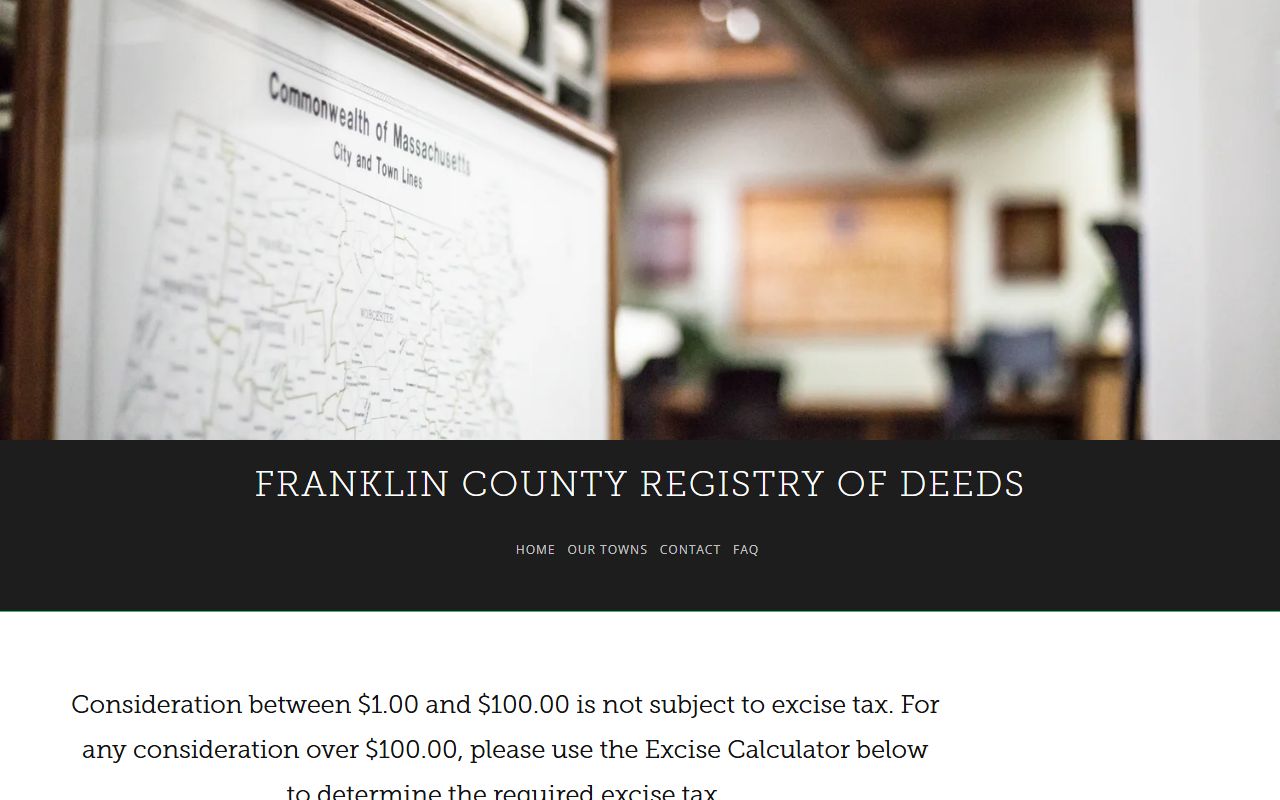
The free excise tax calculator at franklindeeds.com shows you the exact tax amount for any deed transfer price before you record.
Massachusetts Homestead Protection
Massachusetts homestead law under MGL Chapter 188 gives residential property owners a way to protect part of their home equity from certain creditors. There are three types. The automatic homestead protects $125,000 with no filing required. A declared homestead, created by signing a Declaration of Homestead form before a notary and recording it at the Registry of Deeds, protects up to $500,000 under the base law. In 2024, the Legislature passed Chapter 150 of the Acts of 2024, which revised protection amounts. Under the Middlesex North Registry's updated guidance, a declared homestead now protects up to $1,000,000. The filing fee is $35 at all registries.
Homeowners 62 or older, or those with a qualifying disability, can file for an elderly or disabled homestead at the same protection level per eligible person. When both members of a couple qualify, protections can stack. The 2024 Homestead Booklet from the Hampden County Registry explains all three types and the 2024 changes in plain terms. The Homestead FAQ from the Secretary of the Commonwealth answers the most common questions about eligibility, filing, and how the protection works.
Homestead protection does not cover mortgage foreclosure, tax liens, or debts that existed before the homestead was filed. It applies only to a primary residence, not to investment properties or vacation homes.
Free Deed Fraud Alerts in Massachusetts
Property fraud is a growing problem. The Consumer Notification Service (CNS) is a free tool that emails you any time a document is recorded in your name at a Massachusetts Registry of Deeds. The FBI has called property and mortgage fraud one of the fastest-growing white-collar crimes in the country. Signing up at cns.masslandrecords.com takes only a few minutes. You create an account with your email address, set a password, and enter the names and city or town locations you want monitored. Up to three properties can be registered per account at the state level.
When any document matching your registered name records in the location you listed, you get an email right away. The service is name-driven, not address-driven, so you may occasionally get an alert for another person with the same name in your town. If you receive an unexpected alert, call your local registry to confirm what was recorded. Some registries like Essex North even offer a free copy of the document when a fraud alert is triggered. The service is free to all Massachusetts residential property owners and is available through the same statewide portal that handles deed searches.
Sign up for the free Consumer Notification Service at cns.masslandrecords.com to get email alerts when documents record in your name at any Massachusetts registry.
How to Get a Copy of a Massachusetts Deed
Free copies of Massachusetts deed records are available at masslandrecords.com. No account is needed. Search by name, address, or book and page, click the result, and the document opens as a PDF that you can print directly from the browser. These copies are not certified, but they show all the same recorded information and work for most everyday uses like confirming ownership or reviewing mortgage terms.
For a certified copy, you contact the Registry of Deeds in the county where the property is located. Find the right registry using the district offices directory from the Secretary of the Commonwealth. Mail requests should include a written request with the book and page number or document number, the owner's name, the property address, and the approximate recording date. Include a check for $1.00 per page payable to that registry, plus a self-addressed stamped envelope. If you do not have the book and page number, add a $5.00 research fee. Most registries process requests within 24 hours of receipt. Plymouth County uses the TitleView system and has its own copy fee schedule, with deeds at $3.00 and mortgages at $20.00. Nantucket and Dukes counties add postage fees for island delivery.
Historical Massachusetts Deed Records
Massachusetts has some of the oldest deed records in the country. The Suffolk Registry of Deeds holds land records going back to 1643, now over 375 years of continuous recorded history. Plymouth County holds Plymouth Colony records from the 1620s, including some of the earliest land transactions in New England. Hampshire County records date to 1662. Many registries have scanned their oldest books and posted them online. Middlesex North and Suffolk County have records from 1629 available to view at no cost. The FamilySearch Massachusetts Genealogy Guide explains how to access microfilm and digital collections for early deed research going back to the 1600s.
The Massachusetts State Archives at 220 Morrissey Blvd., Boston holds the original Suffolk Deeds collection from 1629 to 1687. These 328 bound volumes are also available on FamilySearch film. Norfolk County completed a major transcription project that converted all handwritten deeds from 1793 to 1900 into readable printed text, making 13.1 million records easier to search. The registry also holds notable records tied to four U.S. Presidents born in Norfolk County. Barnstable County lost almost all pre-1827 records in a courthouse fire in October 1827. Emergency legislation in 1828 allowed property owners to re-record old deeds, and those town books are now part of the online record set available through the Barnstable search portal.
Browse Massachusetts Deed Records by County
Each of the 14 counties in Massachusetts has its own Registry of Deeds. Some counties have more than one registry district. Pick a county below to find contact info, search portals, recording fees, and local resources for deed records in that area.
View All 14 Massachusetts Counties
Deed Records in Major Massachusetts Cities
Massachusetts cities file deed records at the county Registry of Deeds that serves their area. Pick a city below to find which registry handles property records there, how to search, and how to request copies.