
Framingham Deed Records Search
Framingham deed records are held at the Middlesex South Registry of Deeds in Cambridge, where you can search property transfers, mortgages, and other land documents going back well over a century. This page walks you through how to find Framingham deed records online or in person, what gets recorded, and where to look when the registry alone isn't enough to answer your question.
Framingham Overview
Where to Find Framingham Deed Records
Deed records for Framingham are kept at the Middlesex South Registry of Deeds. The office is not in Framingham itself. It sits in Cambridge at 208 Cambridge Street, which can surprise people the first time they go looking. The registry covers Framingham along with Cambridge, Somerville, Newton, Waltham, Medford, Malden, Everett, Brookline, and more than 30 other communities across the southern portion of Middlesex County. Register Maria C. Curtatone leads the office.
| Registry | Middlesex South Registry of Deeds |
|---|---|
| Address | 208 Cambridge Street Cambridge, MA 02141 |
| Phone | (617) 679-6300 |
| Hours | Monday through Friday, 8:00 AM to 4:00 PM |
| Register | Maria C. Curtatone |
| Website | massrods.com/middlesexsouth |
| Online Records | masslandrecords.com/middlesexsouth |
Middlesex County has two separate registry districts. Middlesex North covers the northern part of the county and operates out of Lowell. Framingham is in the southern district, so all Framingham property filings go through the Cambridge office. If you make the trip to search or file records in person, plan to go early. The registry gets busy, especially during active real estate periods. Staff at the counter can assist with basic searches, and public terminals are open throughout office hours.
One important note: the registry accepts documents for Framingham just as it does for any other community it serves. There is no separate filing process for Framingham properties. You bring (or mail, or e-record) your documents to the Cambridge office, pay the fee, and the registry records and indexes them for public access. The only thing that varies is the excise tax calculation, which is based on the sale price stated in the deed.
How to Search Framingham Deed Records Online
The free online portal for Framingham deed records is Massachusetts Land Records at masslandrecords.com/middlesexsouth. This state system lets you search recorded documents by grantor name, grantee name, or book and page number. Most records are available as scanned images you can view and print at no cost. The search covers a broad date range and is the fastest way to find most documents.
To run a search, go to the Middlesex South section of the site. Enter a last name in the grantor or grantee field, set a date range if you know roughly when the transaction occurred, and click search. The results list will show document types, recording dates, and book and page references. Click any result to open the scanned image. You can also search by address in some cases, though name-based searches tend to produce the most reliable results. If you know the book and page number from a prior search or a title rundown, you can jump directly to that document.
For certified name searches, the CNS tool at cns.masslandrecords.com provides a formal search report you can download. This is used mainly by attorneys and title companies for real estate closings. CNS searches carry a fee, unlike the basic image search. The registry's own website at massrods.com/middlesexsouth also has information on e-recording, fee schedules, and office announcements.
When you are researching a Framingham property transfer, the excise tax calculator at franklindeeds.com can be a helpful tool. It lets you work out what the excise tax would be on a given sale price, which is useful when cross-checking the numbers recorded in a deed or estimating the tax on an upcoming transaction.
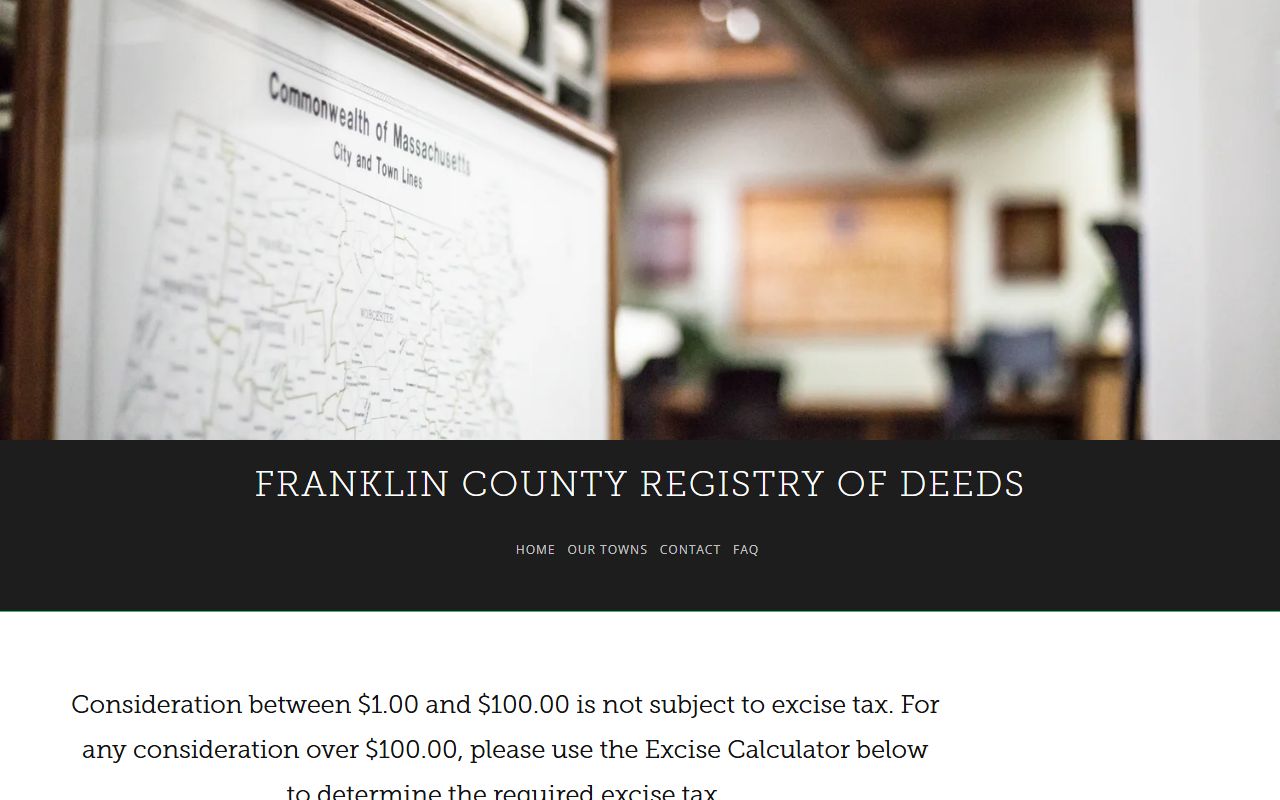
The image above shows a Massachusetts deed excise tax calculator, a useful reference when reviewing Framingham property transfers and checking the tax amount tied to a recorded deed.
Framingham: Massachusetts's Newest City
Framingham holds a unique place in Massachusetts history. For more than 300 years it operated as a town, one of the oldest in the state. In 2017 residents voted to change that, and Framingham became a city, the first new city in Massachusetts in decades. The change took effect January 1, 2018. This made Framingham officially the newest city in the Commonwealth and gave it a mayor-council form of government in place of the old town meeting structure.
This matters in a practical way when you search deed records. Before 2018, documents recorded for Framingham properties reference it as a town. After 2018, it is listed as a city. If you are doing a title search that spans the transition, you may see both "Town of Framingham" and "City of Framingham" in the chain of title depending on when a document was recorded. The change in municipal status had no effect on how deeds are recorded or which registry handles them. The Middlesex South Registry in Cambridge served Framingham before 2018 and continues to serve it today.
Framingham is among the largest communities in Middlesex County by population. At roughly 72,000 residents, it is bigger than many places that already had city status. The real estate market here is active, and the registry processes a significant number of Framingham-related documents each year. Deeds, mortgages, discharges, and homestead declarations for Framingham properties are all part of the Middlesex South record set you can search online.
What Documents Are Recorded at the Registry
The Middlesex South Registry records a range of documents that affect real property in Framingham. Deeds are the most common type. A deed transfers ownership from one party to another, and under MGL Chapter 183, a deed is not legally effective against third parties until it is recorded. That is why recording matters. Without a recorded deed, a buyer has no public notice of their ownership, and title issues can arise later.
Mortgages are recorded when a property owner borrows against the property as security. When the loan is paid in full, the lender records a discharge of mortgage to clear the lien. Homestead declarations are recorded by homeowners who want to protect their primary residence from certain creditor claims. Easements, attachments, liens, notices of lis pendens, and plans are other document types you may find in a Framingham title search. The registry indexes all of these by grantor and grantee name, so a complete name search across the ownership history of a parcel will turn up all recorded documents tied to that property.
The registry also handles plans. When a Framingham property is subdivided, a new plan must be approved and recorded. Plans show lot dimensions, boundaries, and street layouts. If you are researching when a lot was created or how it relates to neighboring parcels, the plan books at the registry are where you need to look. Plan images are available online through masslandrecords.com alongside deed and mortgage records.
Recording Fees and Excise Tax
When you record a document at the Middlesex South Registry for a Framingham property, you pay a recording fee set by state law. The fees below apply at this registry and at most Massachusetts registries statewide. Fees are the same whether you are filing in person, by mail, or through an e-recording vendor.
| Document Type | Recording Fee |
|---|---|
| Deed | $155 |
| Mortgage | $205 |
| Discharge of Mortgage | $105 |
| Homestead Declaration | $35 |
In addition to the recording fee, a deed transfer triggers a Massachusetts excise tax. The rate is $4.56 per $1,000 of the sale price. This is split between the state and Middlesex County. You pay the excise tax at the time of recording. The tax is based on the actual sale price stated in the deed, not the assessed value. So a Framingham property that sells for $500,000 would generate an excise tax of $2,280 at recording. Exemptions exist in some cases, including transfers between family members and certain first-time buyer situations. An attorney or title company can advise on whether an exemption applies to your transaction.
The registry accepts check, money order, and in some cases credit card. Call (617) 679-6300 before your visit to confirm what payment types are accepted right now. Most attorneys and title companies handle recording as part of the closing process, so individual buyers typically do not need to go to the registry themselves. If you are recording on your own without an attorney, the registry staff can help you make sure documents are in the right form before they are accepted.
Framingham City Assessor Records
The Framingham City Assessor keeps property records that work alongside the deed records at the registry. Where the registry holds the actual legal documents, the assessor tracks ownership, assessed value, and property details for every parcel in Framingham. Both sources together give you a more complete picture of any given property than either one does on its own.
The assessor's office is at City Hall, 150 Concord Street, Framingham, MA 01702. You can reach them by phone at (508) 532-5450 or through the city's website at framinghamma.gov/assessing. The online property database lets you search by address or owner name to get the current assessed value, building characteristics, and recent sale history for any Framingham parcel. This is free and does not require an account.
| Office | Framingham City Assessor |
|---|---|
| Address | City Hall, 150 Concord Street, Framingham, MA 01702 |
| Phone | (508) 532-5450 |
| Website | framinghamma.gov/assessing |
The assessor's records are updated annually when the city sets new values. Keep in mind that the assessed value shown in the database reflects the city's mass appraisal estimate, not the actual sale price. The registry deed is the authoritative record of what a property sold for. If you are trying to determine what a Framingham property last sold for, check the deed at the registry. If you need the assessed value for tax or other purposes, check the assessor's database.
How to Declare a Homestead in Framingham
Massachusetts allows homeowners to protect their primary residence through a homestead declaration. Once recorded, a homestead protects up to $500,000 of equity in your home from certain creditor claims. This protection is available to any owner who occupies the property as their principal residence. It does not protect against mortgage lenders, tax liens, or certain other obligations, but it does shield equity from most unsecured creditors.
To declare a homestead for a Framingham property, you file a Declaration of Homestead with the Middlesex South Registry of Deeds. The form must be signed by the owner and notarized before submission. You can get the form from the registry or find it online through the registry's website. The recording fee is $35. Once filed, the homestead protection attaches to the property and stays in place as long as you occupy it as your primary home. If you sell or move, you would need to file a new declaration if you want protection on a new property.
A few things to know before you file. Married couples who both own the property should each sign the declaration to ensure both are protected. There is also an "automatic" homestead of $125,000 that exists under Massachusetts law without any filing, but the declared homestead of $500,000 requires the recorded document. Given that the recording fee is only $35, filing the declaration is generally worth doing for any Framingham homeowner. An attorney can help if you have questions about whether your property qualifies or how the protection interacts with other liens on the property.
Middlesex County Deed Records
Framingham is part of Middlesex County and the Middlesex South Registry District. The county page covers the full district in more detail, including how Middlesex North and South differ, electronic recording options, and resources for other communities across the county.
Nearby Cities
These nearby cities also have deed records pages with registry info, search tools, and local resources.