
Find Deed Records in Plymouth
Plymouth deed records are kept at the Plymouth County Registry of Deeds, which is physically located in Plymouth at 50 Obery Street -- making this one of the few Massachusetts cities where residents can walk in to the county registry without driving to another town. If you need to search property transfers, mortgages, historical land grants, or any other recorded instruments tied to Plymouth real estate, you can look them up online for free or visit the office in person during regular business hours.
Plymouth Overview
Where Plymouth Deed Records Are Kept
Plymouth is home to the Plymouth County Registry of Deeds. That is worth noting because most cities in Massachusetts have to send residents to another town to visit the county registry. Not Plymouth. The office sits right here at 50 Obery Street, which means you can check on a document, request a certified copy, or record a new deed without leaving the city. This is a real convenience for homeowners, real estate attorneys, and title companies who work with Plymouth property regularly.
The registry serves Plymouth and 27 other cities and towns across Plymouth County, including Brockton, Abington, Bridgewater, Hanover, Hingham, Hull, Kingston, Pembroke, Rockland, Scituate, and Whitman. Register John R. Buckley, Jr. oversees the office. All property documents recorded anywhere in Plymouth County -- deeds, mortgages, discharges, liens, easements, and more -- are stored and indexed here. For Plymouth property specifically, this is the one and only official source for recorded land documents.
| Registry | Plymouth County Registry of Deeds |
|---|---|
| Address | 50 Obery Street Plymouth, MA 02361 |
| Phone | (508) 830-9200 |
| Fax | (508) 830-9280 |
| buckley@plymouthdeeds.org | |
| Office Hours | Monday through Friday, 8:30 AM to 4:30 PM |
| Recording Hours | Monday through Friday, 8:30 AM to 4:00 PM |
| Register | John R. Buckley, Jr. |
Pay attention to the gap between office hours and recording hours. The front desk stays open until 4:30 PM, but the cutoff for submitting documents to be recorded that same day is 4:00 PM. If you bring a deed in at 4:15 PM, it will be held and recorded the following business day. For closings with same-day recording deadlines, arrive well before 4:00 PM.
How to Search Plymouth Deed Records Online
Plymouth County offers two main online systems for searching deed records, and both are free to use. The first is the Massachusetts Land Records platform at masslandrecords.com/plymouth. This is the statewide system that covers all Massachusetts registries, and the Plymouth section lets you search by grantor name, grantee name, document type, and date range. You can view full document images in your browser at no cost. Most modern recordings from the past several decades are available here.
The second system is TitleView, accessible at titleview.org. Title examiners and real estate attorneys use TitleView heavily for Plymouth County work. It has a different interface than masslandrecords.com and is worth trying if you do not find what you need in the first system. Some users find it better for chain-of-title work where you need to follow a property's ownership back through multiple transactions. The registry's primary website at plymouthdeeds.org links to both systems and offers guidance on how to use them.
For searches that cross county lines, the Consolidated Name Search at cns.masslandrecords.com lets you search multiple Massachusetts registries at once. If you are not sure whether a document was filed in Plymouth County or a neighboring county, CNS can save time by checking several registries in a single query. For Plymouth property, though, you will almost always be searching Plymouth County only.
When searching online, start with at least one party's last name and a rough year range. If you get too many results, add a document type filter -- for example, limiting results to "deeds" rather than all instrument types. The street address alone is not usually a primary search field, but knowing the book and page number of a specific document makes retrieval much faster, both online and in person.
The official source for Plymouth deed records is plymouthdeeds.org, the Plymouth County Registry of Deeds website, which is also physically located here in Plymouth at 50 Obery Street.
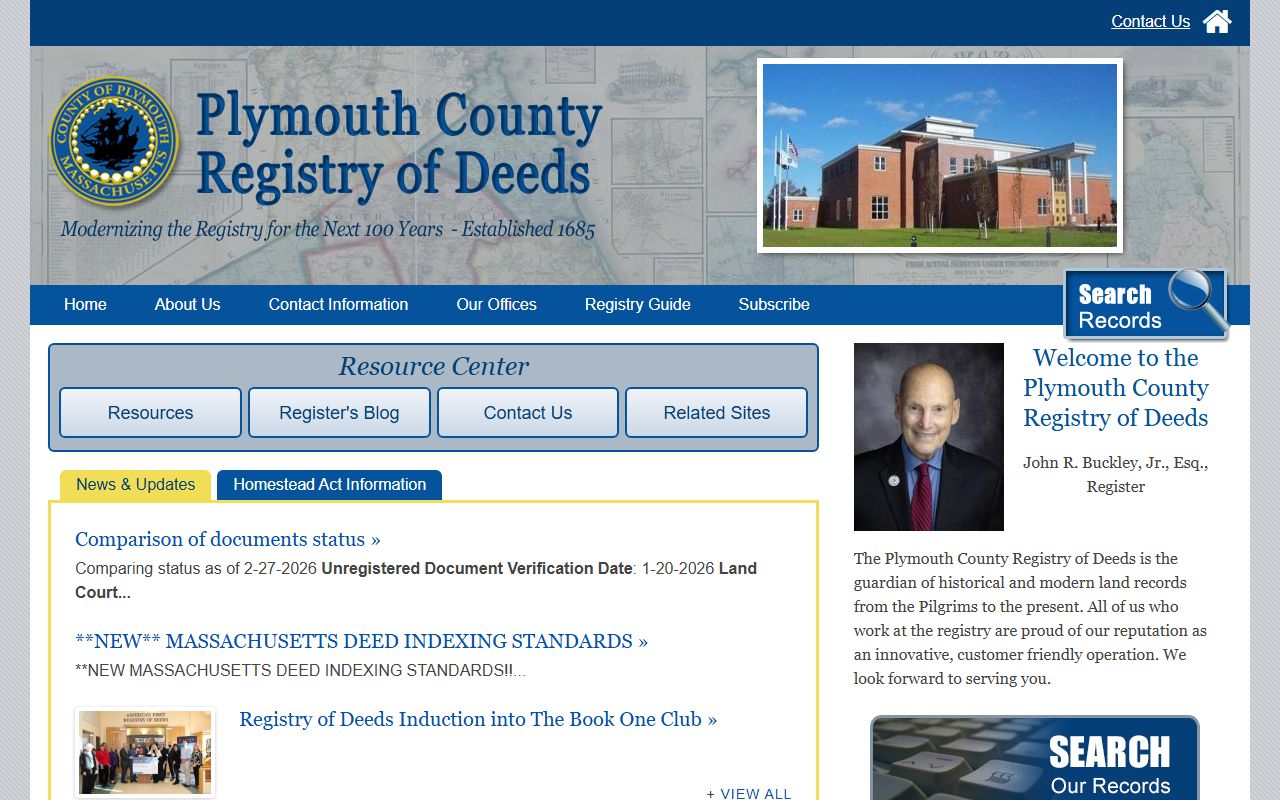
The registry site links directly to the masslandrecords.com search portal and the TitleView system, and lists current fees, recording requirements, and contact information for the Plymouth office.
Plymouth Land Records: A Deep History
Plymouth has the oldest property records in Massachusetts, and arguably among the oldest in all of New England. The Pilgrims arrived at Plymouth in 1620, and land transactions began almost immediately as the colonial settlement grew and parcels were distributed to settlers. The Plymouth Colony maintained records of land grants, lot divisions, and transfers going back to the 1620s. When Plymouth Colony was absorbed into the Province of Massachusetts Bay in 1692, those early records became part of the broader colonial record system. If you are researching property that goes back to the 17th or 18th century, Plymouth is one of the few places in the country where that kind of deep historical research is possible.
The current Plymouth County Registry of Deeds holds records dating back to 1620, making it one of the oldest registries in the United States. These earliest records include Pilgrim-era land grants and colonial lot assignments that predate the formal registry system. Researchers doing genealogy, historical property research, or title work on very old parcels may encounter records in multiple formats -- early handwritten volumes, microfilm, and digitized scans. Not all historical records are available through the online systems. For documents from the 17th and early 18th centuries, an in-person visit to the Plymouth registry or contact with the registry staff is often necessary to locate and retrieve specific instruments. The registry can direct you to the right volume and page for older research requests.
This historical depth is one reason the Plymouth registry attracts researchers from well beyond Plymouth County. Genealogists tracking early Massachusetts families often need to work through Plymouth deed books to trace property ownership tied to family lineage. The records here are not just useful -- they are irreplaceable.
Document Types Recorded for Plymouth Property
Many different instruments can be recorded at the Plymouth County Registry for Plymouth real estate. The most common is the deed, which transfers ownership from seller to buyer and creates the core paper trail for any piece of property. But deeds are just the start. Mortgages are recorded when a property owner borrows against real estate -- the mortgage document creates a lien that stays on record until paid off. Once the loan is satisfied, the lender records a discharge of mortgage to release the lien. Discharges should follow payoff relatively quickly, but occasionally a discharge is delayed or missed, which can create title problems at a future sale. If you suspect a discharge was not recorded, the registry office can help you track it down.
Homestead declarations are another common filing in Plymouth. Under Massachusetts law, a homestead declaration protects a primary residence from certain creditors up to a set amount. The declaration must be recorded at the registry to take effect. Easements are recorded to document rights to use land in specific ways -- shared driveways, utility corridors, access paths, and similar arrangements. Lis pendens notices signal that active litigation could affect a property's title. Assignments of mortgage, subordination agreements, and attachments also show up regularly. Plans showing lot lines and survey information may be recorded as well. For Plymouth, where some parcels trace back centuries and may have complex easement or boundary histories, checking for all instrument types -- not just deeds -- is important for a thorough title review.
Recording Fees for Plymouth Deeds
Recording fees at the Plymouth County Registry are set by Massachusetts state law under MGL Chapter 183. The fees apply equally to all documents recorded in the registry, whether for Plymouth property or any other community in the county. The standard fee for recording a deed is $155. A mortgage costs $205 to record. A discharge of mortgage is $105. A declaration of homestead is $35.
In addition to the base recording fee, most deed transfers are subject to the Massachusetts real estate excise tax, commonly called the deed excise. The rate is $4.56 per $1,000 of the purchase price. A Plymouth home selling for $500,000 would carry a deed excise of $2,280, plus the $155 recording fee. The excise tax is collected at the time of recording. Deeds that qualify for an exemption -- such as transfers with no consideration between family members -- require a completed exemption form in lieu of the excise payment. The registry will not record a deed without either the tax payment or a valid exemption.
Copies of recorded documents carry a separate fee. If you only need to view a document, the online systems let you do that for free. Certified copies for official use must come from the registry directly. Call (508) 830-9200 for current copy pricing before visiting.
Plymouth Town Assessor
The Plymouth Town Assessor's office is a separate resource from the registry. The assessor tracks current property ownership, assessed values, and tax information for all real estate in Plymouth. These records are useful for confirming who owns a property right now, finding the parcel ID or map-lot number for a registry search, and checking the assessed value for tax purposes. The assessor updates its database on an annual cycle tied to the January 1 assessment date, so very recent ownership changes may not yet show up there. For the most current ownership information, the registry deed records are more up to date.
The Plymouth Assessor's office is at Town Hall, 11 Lincoln Street, Plymouth, MA 02360. The phone number is (508) 747-1620 ext. 246. You can also access property data online through the town's website at plymouth-ma.gov/assessors. Looking up the parcel information in the assessor's database before heading to the registry can save time -- you can grab the owner's name and map-lot reference, which helps narrow a name search in the deed records system.
Getting Copies of Plymouth Deed Records
If you need a copy of a recorded document for Plymouth property, you have a few options. The easiest and cheapest is to pull the document image through masslandrecords.com or TitleView and print it yourself. The image you get this way is a copy of the recorded document but is not certified. For most personal or informational purposes, that is fine.
If you need a certified copy for a real estate closing, a legal proceeding, or another official purpose, you have to get it from the Plymouth County Registry directly. Because the registry is right here in Plymouth at 50 Obery Street, an in-person visit is simple. Bring the book and page number of the document if you have it -- that speeds up the process significantly. Staff can also search by name or date if you do not have the book and page reference, but it takes more time. You can also request certified copies by mail: write to the registry with the document details, your return address, and a check for the copy fee. The registry will send the certified copy back to you. Allow a few extra days for mail requests. For time-sensitive needs, visiting in person is faster.
Plymouth County Deed Records
Plymouth is both a city and the location of the Plymouth County Registry of Deeds. For full details on the registry, the TitleView system, historical records going back to 1620, recording requirements, and resources for all 28 communities in the county, visit the Plymouth County deed records page.
Nearby Cities
Other qualifying cities near Plymouth with their own deed records pages: