
Barnstable County Deed Records
Barnstable County deed records are kept at the Registry of Deeds in Barnstable, serving all 15 towns on Cape Cod. The registry holds recorded land documents going back to 1704, and you can search deed records online through the registry's own search portal at search.barnstabledeeds.org or visit the office in person on Main Street in Barnstable. Whether you need a copy of your deed, want to check for liens, or are tracing property back through Cape Cod history, this is where you start.
Barnstable County Overview
Barnstable County Registry of Deeds
The Barnstable County Registry of Deeds sits at 3195 Main Street in Barnstable, Massachusetts. John F. Meade has served as Register since 1989, making him the longest-serving Register in Massachusetts history. He took office when the registry was still converting paper records, and by 1999 all records were in computer format. Electronic filing launched in 2014. The registry covers every town on Cape Cod, from Sandwich at the canal to Provincetown at the tip, and holds more than 36,500 record books along with over 1.5 million Land Court documents.
You can reach the registry by phone at (508) 362-7733 or fax at (508) 362-5065. Email is info@Barnstabledeeds.org. The Public Records Access Officer is David B. Murphy, Esq. The registry website is capecod.gov/departments/registry-of-deeds, and the direct search portal is at search.barnstabledeeds.org. Office hours are Monday through Friday, 8:00 AM to 4:00 PM.
| Registry | Barnstable County Registry of Deeds |
|---|---|
| Address |
3195 Main Street, P.O. Box 368 Barnstable, MA 02630 |
| Phone | (508) 362-7733 |
| Fax | (508) 362-5065 |
| info@Barnstabledeeds.org | |
| Hours | Monday through Friday, 8:00 AM to 4:00 PM |
| Website | capecod.gov/departments/registry-of-deeds |
| Online Search | search.barnstabledeeds.org |
Note: The registry serves all 15 Cape Cod towns and has no satellite offices, so plan your visit to the Main Street location in Barnstable if you need in-person help.
The 1827 Courthouse Fire and Lost Deed Records
On October 22, 1827, a fire broke out at the Barnstable County Court House, across from what was then the Crocker Tavern. Three men playing cards nearby spotted the blaze and rushed in to save what they could. Despite their efforts, the fire destroyed 94 volumes of Registry of Deeds records, wiping out nearly the entire collection. Only one volume survived: Volume 61, covering the years 1804 to 1808. That book is still on display today in a glass case in the registry lobby. You can also view it online through the FamilySearch Catalog.
The fire also destroyed Registry of Probate and Clerk of Courts records. The loss was enormous. The Massachusetts legislature responded with Acts of 1828, Chapter CVIII, which created a Town Books System that ran from March 23, 1828 to May 1, 1829. During that time, each Cape Cod town operated its own temporary registry. Any deed not more than 40 years old could be re-recorded. Those Town Books have since been scanned and indexed as part of the regular record collection, so they show up in searches today like any other recorded document.
Register Lothrop Davis served through the fire and continued in office until 1859. His tenure and the emergency re-recording effort are why the current index goes back as far as it does despite the destruction. When you search Barnstable deed records and find gaps or re-recorded volumes, the 1827 fire is why. Knowing this history helps you understand why some searches produce fewer results than expected for the early 1800s.
Search Barnstable County Deed Records Online
The main tool for searching Barnstable County deed records online is the registry's own portal at search.barnstabledeeds.org. The system works with Chrome, Safari, Edge, and Firefox. Internet Explorer is not supported. The portal is also mobile-friendly, so you can use it on a tablet or phone. If you plan to print anything, you will need to enable pop-ups in your browser first.
The portal includes a useful "Find My Deed" tool. You enter a name and a town, and the system pulls up matching records quickly. You can also search Land Court records by name, document number, certificate number, encumbrances, or entry date. One thing to keep in mind: the address search is helpful but it is not an official index. Do not rely on it alone for a complete title search. Name searches are the reliable method. The portal gives free access to obscured copies of documents, which display with a "not an official copy" watermark. Clean copies cost $1 per page.
The online search portal at search.barnstabledeeds.org is where you will find most of what you need, and it is available around the clock.
The Barnstable County Registry of Deeds online search portal at search.barnstabledeeds.org provides free access to recorded land documents for all 15 Cape Cod towns.
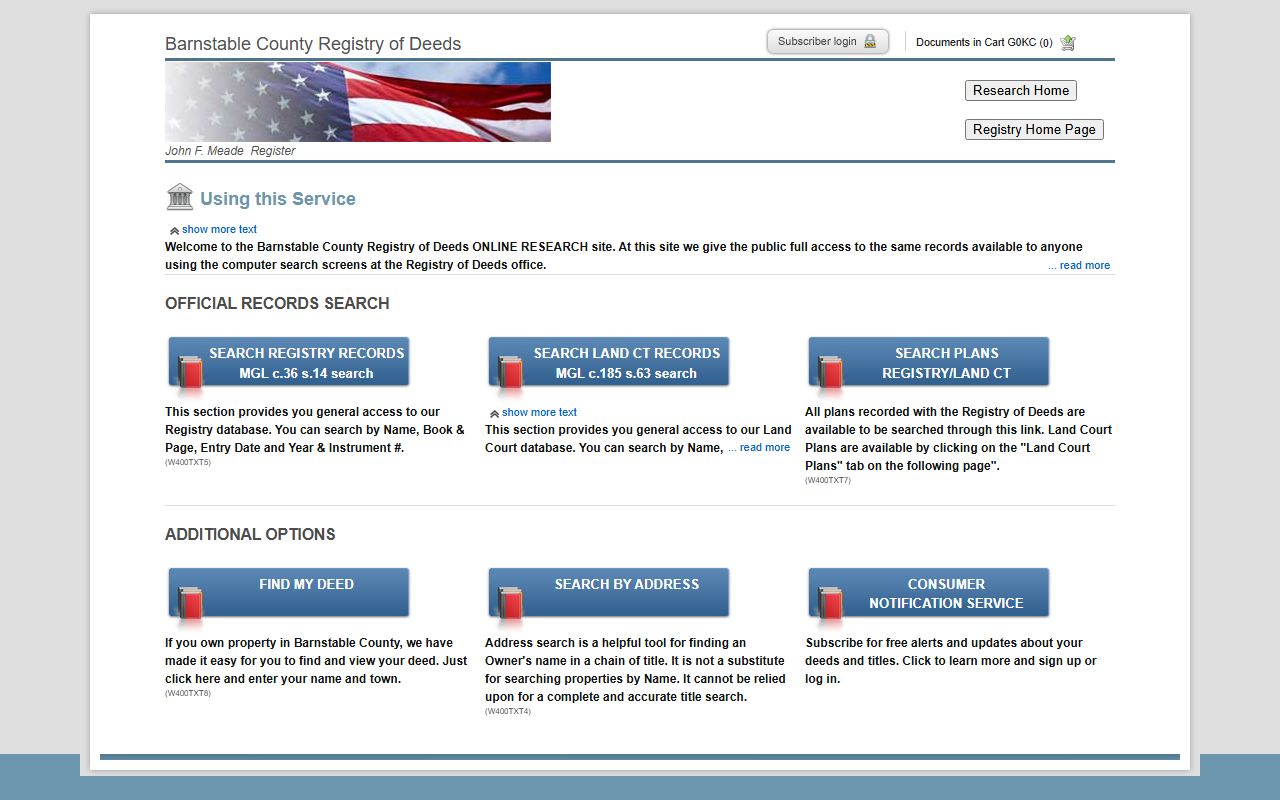
The search portal supports name searches, document number lookups, and Land Court record searches, and it works on both desktop and mobile devices without needing an account.
What Barnstable Deed Records Are Available
The index coverage at Barnstable County is extensive. Recorded Land and Registry Deeds run from 1704 to the present, with both index and images available. Land Court Records are indexed and imaged from 1899 to present. The specific deed volumes include Volumes 1 through 88, covering 1815 to 1868. Indexes for the period 1703 to 1868 are also searchable. Recopied Deeds, which were created as part of the post-fire recovery effort, run from 1783 to 1870 and are organized by town. Mashpee town records run from 1831 to 1870.
A standard Barnstable County deed shows the names of the grantor and grantee, a description of the property, the date of the transfer, the consideration paid, and the book and page number assigned at recording. Deeds must comply with MGL Chapter 183, which governs conveyances in Massachusetts. Beyond deeds, the registry holds mortgages, discharges of mortgage, homestead declarations, attachments, liens, easements, and subdivision plans. Homestead declarations under MGL Chapter 188 protect a portion of a home's equity from creditors.
The registry also handles registered land under a separate system governed by MGL Chapter 36. Registered land has its own certificates of title and works through a different process than recorded land. If you are not certain which type applies to a property, staff at the office can help you sort it out. The over 36,500 record books and 1.5 million Land Court documents represent one of the more complete Cape Cod land record collections you will find anywhere.
Deed Recording Fees and Copy Costs
Barnstable County uses the standard Massachusetts fee schedule. A deed costs $155 to record. A mortgage is $205. A discharge of mortgage is $105. A homestead declaration is $35. Copies of recorded documents cost $1 per page for clean copies. Obscured copies, which show the watermark "not an official copy," are free through the online portal. You can review the full fee schedule at capecod.gov's fee schedule page.
If you pay by credit card for online copies, there is a $4 convenience fee for transactions up to $100, and 4% for transactions over $100. You can also use a Cape View account if you are a frequent user of the registry's services. The Massachusetts real estate excise tax applies to all deed recordings at a rate of $4.56 per $1,000 of the sale price. On a $400,000 property, that comes to $1,824 in transfer tax paid at the time of recording.
The fee schedule and recording procedures page at capecod.gov lists current costs for all document types recorded at the Barnstable County Registry of Deeds.
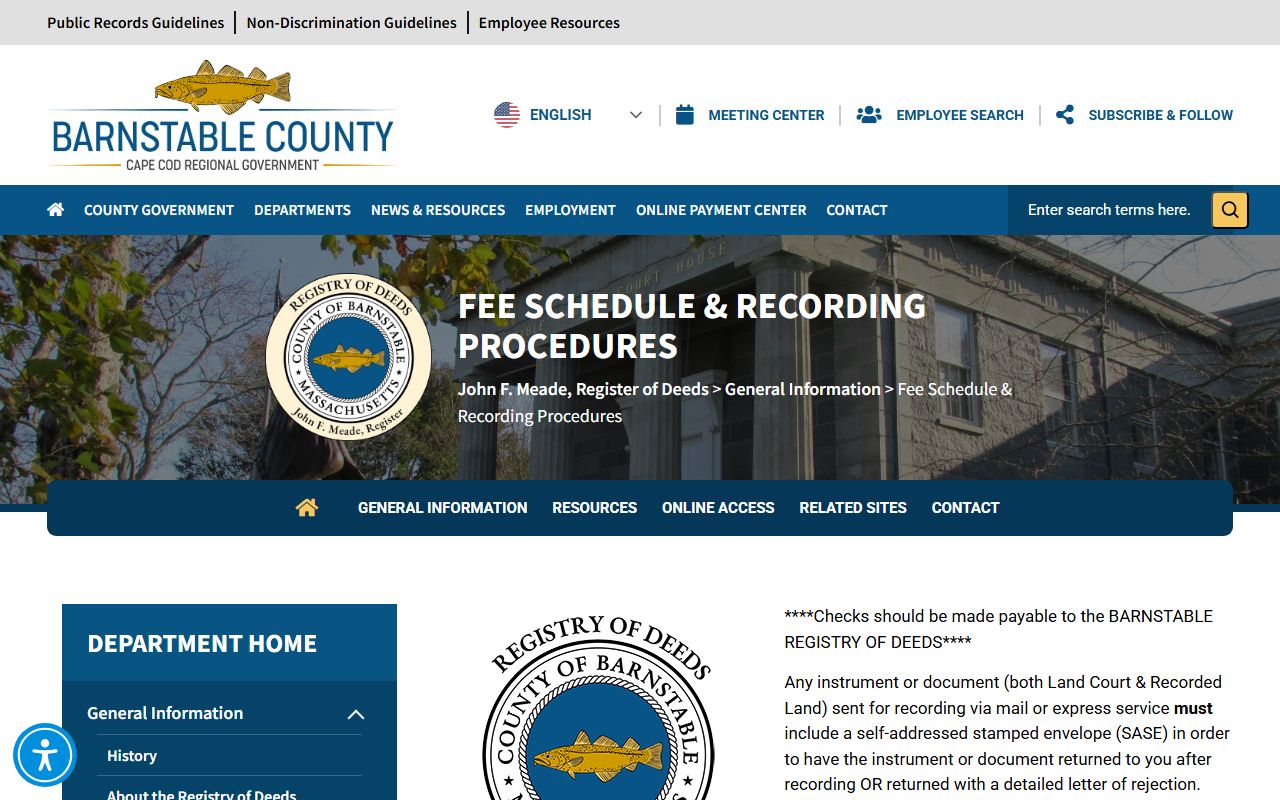
The fee page covers recording costs, copy fees, credit card convenience charges, and the excise tax rate that applies when you record a deed transfer in Barnstable County.
Note: Confirm payment methods before you visit or mail a document, as accepted forms of payment can change and the registry may have specific requirements for different transaction types.
Seasonal Research on Cape Cod
Barnstable County is Cape Cod, and Cape Cod has a very distinct seasonal pattern. The population swells significantly from late spring through early fall, and so does real estate activity. If you are trying to record a deed, get a copy, or visit the office in person during the summer months, plan for more foot traffic and potentially longer wait times. The office is open year-round, Monday through Friday, 8:00 AM to 4:00 PM, but spring and summer bring a noticeably higher volume of transactions.
The online search portal at search.barnstabledeeds.org is available 24 hours a day, 7 days a week. If you just need to look up a record or pull a copy, doing it online avoids the in-person rush entirely. Electronic filing is available for attorneys and title companies that record frequently. You can find information on e-filing at capecod.gov's electronic filing page. For most research purposes, the online portal handles everything without a trip to Barnstable.
Historical Deed Records and Genealogy Research
Barnstable County was established in 1685, and its towns include some of the oldest communities on Cape Cod. Sandwich and Barnstable were both incorporated in 1639. Eastham dates to 1646. Yarmouth goes back to 1680. These deep roots mean the registry's records have significant value for genealogical research, even with the 1827 fire gap. The index runs back to 1703, and the recopied deed volumes pick up much of what was lost.
For historical deed research, the Sturgis Library in Barnstable is worth knowing about. The library holds historical deed materials for the area and is a useful stop if you are tracing property or family connections back through the 18th and 19th centuries. You can find out more at sturgislibrary.org/deeds. The surviving Volume 61 from before the fire is also viewable online through the FamilySearch Catalog entry for Barnstable County, so you do not have to visit in person to see it.
The registry's FAQ page at capecod.gov's frequently asked questions page covers common questions about accessing records, getting copies, and how the recording process works. It is a good first read if this is your first time using the Barnstable County system.
- Recorded Land index and images: 1704 to present
- Land Court Records: 1899 to present
- Deed volumes 1-88: 1815 to 1868
- Recopied Deeds by town: 1783 to 1870
- Mashpee town records: 1831 to 1870
- Indexes: 1703 to 1868
The 15 Cape Cod towns served by the registry are Barnstable, Bourne, Brewster, Chatham, Dennis, Eastham, Falmouth, Harwich, Mashpee, Orleans, Provincetown, Sandwich, Truro, Wellfleet, and Yarmouth. All deed records for these communities are filed at the single registry location on Main Street. There are no qualifying cities in Barnstable County for separate city-level pages, but many of these towns have long records histories worth exploring if you are doing title research or genealogy work.
Nearby Counties
Barnstable County covers all of Cape Cod, but property research sometimes crosses county lines, especially for towns near the canal or for historical records that predate current boundaries. Plymouth County borders Barnstable County to the north and west.