
Berkshire County Deed Records
Berkshire County deed records are split across three separate Registry of Deeds districts, each serving a different part of the county, with offices in Adams, Pittsfield, and Great Barrington. All three registries have records going back to 1761, and you can search deed records online at masslandrecords.com or contact the district office that covers the town you need.
Berkshire County Overview
Why Berkshire County Has Three Registry Districts
Most Massachusetts counties have one Registry of Deeds. Berkshire County has three. The reason comes down to geography. Berkshire County is long and narrow, running north to south through the western edge of the state, cut through by mountain ranges and valleys. In the 1800s, getting from the southern end of the county to the northern end took hours, and residents could not reasonably travel to a single central office to record land documents. The state responded by creating three separate districts, each with its own Register of Deeds and its own set of books going back to 1761.
The three districts are: North (based in Adams), Middle (based in Pittsfield), and South (based in Great Barrington). Each district covers a distinct set of towns and maintains its own independent records. If you need deed records for a Berkshire County property, the first step is figuring out which town the property is in, then finding the right district for that town. Searching the wrong district will not return results, because the records do not overlap.
All three districts are part of the Massachusetts Secretary of State's office, and all three connect to the statewide land records portal. The online search tools work the same way across all three, but each has its own database and index.
Berkshire North Registry of Deed Records
The Berkshire North Registry is located at 7 North Street, 3rd Floor, in Adams, MA 01220. Maria T. Ziemba serves as Register. The office handles deed records for 11 towns in the northern part of the county: Adams, Cheshire, Clarksburg, Florida, Hancock, Lanesborough, New Ashford, North Adams, Savoy, Williamstown, and Windsor. The office was established in 1761, making it one of the older recording offices in the state. You can reach the office by phone at (413) 743-0035 or by fax at (413) 743-1003. Email is nbrd@sec.state.ma.us. Hours run Monday through Friday, 8:45 AM to 4:30 PM.
Online deed records for the North district are at masslandrecords.com/BerkNorth. The district registry site is at massrods.com/berkshirenorth. What you can find online depends on when a document was recorded. Pre-1960 recorded land records are available, along with land records from 1761 to 1985 (images go from 1761 to 1925; the index runs from 1761 to 1985). Recorded plans go back to 1770. Registered land records are available from 1944 forward, and registered land plans from 1899 forward. Colonial records and proprietary plans are also available for those doing deep historical research in the North Berkshire area.
Note: If you are not sure whether a town in the northern part of Berkshire County falls under the North district, contact the Adams office directly before making a trip or submitting documents.
Berkshire Middle Registry of Deed Records
The Berkshire Middle Registry sits at 44 Bank Row in Pittsfield, MA 01201. Patricia Harris is the current Register, the 14th to serve in that role since the office was established in 1790. Harris is a native of Pittsfield who worked as a paralegal and title searcher before being elected Register. She also serves as President of the Massachusetts Registers and Assistant Registers of Deeds Association. The Middle district covers 12 towns: Becket, Dalton, Hinsdale, Lee, Lenox, Otis, Peru, Pittsfield, Richmond, Stockbridge, Tyringham, and Washington. You can reach the office at (413) 443-7438, fax at (413) 448-6025, or email Patricia.Harris@sec.state.ma.us. Hours are Monday through Friday, 8:45 AM to 4:30 PM.
The Middle district has two online access points. The state portal at masslandrecords.com/BerkshireMiddle gives you free access to deed images. The district site at massrods.com/berkshiremiddle has additional information about the office and its services. Historical records include pre-1970 grantor and grantee indexes, land records from 1761 to 1925, indexes from 1761 to 1907, and an unindexed property search tool that covers 1761 to 1969. County Commissioner Plans go back to 1800, and registered land plans are available from 1899 forward.
The Middle district offers a few services worth knowing about. The Consumer Notification Service sends you a free email alert any time a document is recorded under your name, which helps catch deed fraud early. You sign up at cns.masslandrecords.com. The office also handles notary oaths by appointment and accepts Land Court documents for review, though you need to email the office before submitting Land Court materials.
Berkshire South Registry of Deed Records
The Berkshire South Registry is at 334 Main Street, Suite 2, in Great Barrington, MA 01230. Michelle L. Laramee-Jenny is the 16th Registrar since 1761. The South district serves the towns in the southern part of the county. You can reach the office at (413) 528-0146, fax at (413) 528-6878, or email sbrd@sec.state.ma.us. Hours are Monday through Friday, 8:45 AM to 4:30 PM.
South district deed records go back to 1761, with online access available at masslandrecords.com/BerkSouth and at the district site massrods.com/berkshiresouth. Pre-1960 records are indexed by grantor and grantee. An unindexed property search tool covers 1731 to 1959 for very old research. Recorded plans are available from 1847 forward, and registered land records and plans are available from 1908 forward. Searching and viewing records online is free. The system requires that pop-ups are enabled in your browser for printing and downloading, and you will need Adobe Reader to open downloaded files.
Search Berkshire County Deed Records Online
All three Berkshire County districts connect to the statewide Massachusetts Land Records portal. Searching is free and does not need an account. You choose the district first, then search by grantor, grantee, document type, or date range. Each district has its own database, so you search one district at a time. If you are not sure which district covers a town, pick the district that seems closest geographically, or check the town lists above for each office.
The portal lets you view scanned images of recorded documents and save or print them. Certified copies have to come from the registry office itself and carry a fee. For properties that changed hands many times, you may need to trace through multiple document numbers across a range of years. The grantor and grantee indexes make this easier for modern records. For older documents outside the indexed range, the unindexed property search tools at the South and Middle districts give you a way to dig further back.
The state portal also connects to the Consumer Notification Service at cns.masslandrecords.com. Any Berkshire County property owner can sign up to get email alerts when a document records in their name at any of the three districts. The service is free. It is a good way to stay aware of activity on your property without checking the registry manually.
Note: Each Berkshire district uses separate login credentials for e-recording and other advanced features, so check the individual district site for details if you file frequently.
Recording Fees and Deed Requirements
All three Berkshire County registries use the same state fee schedule. Recording a deed costs $155. A mortgage is $205. A discharge of mortgage is $105. Homestead declarations cost $35. Plans run $105 per sheet. Copies are $1 per page. These fees apply at the North, Middle, and South districts alike. Payment types vary by office, so confirm before you go or mail documents.
When you record a deed in Massachusetts, you also owe the real estate excise tax. The rate is $4.56 per $1,000 of the stated sale price. On a $400,000 sale, that works out to $1,824 in transfer tax paid at recording. You can estimate the cost ahead of time using the calculator at franklindeeds.com/excise-tax-calculator. The tax applies to all deeds statewide, including all Berkshire County districts. Documents that do not meet the standard recording requirements may be sent back.
Massachusetts recording requirements for deeds come under MGL Chapter 183, which governs conveyances across the state. Chapter 183 covers what must be in a deed, how documents must be acknowledged, and what the registry needs to record a document. Homestead declarations fall under MGL Chapter 188, which sets out the protections available and how to file. If you are not sure whether a document is ready to record, the registry staff at whichever district you are using can point you in the right direction.
The Massachusetts Land Records portal at masslandrecords.com is where you start for all three Berkshire County Registry districts, giving free access to deed images and grantor-grantee indexes.
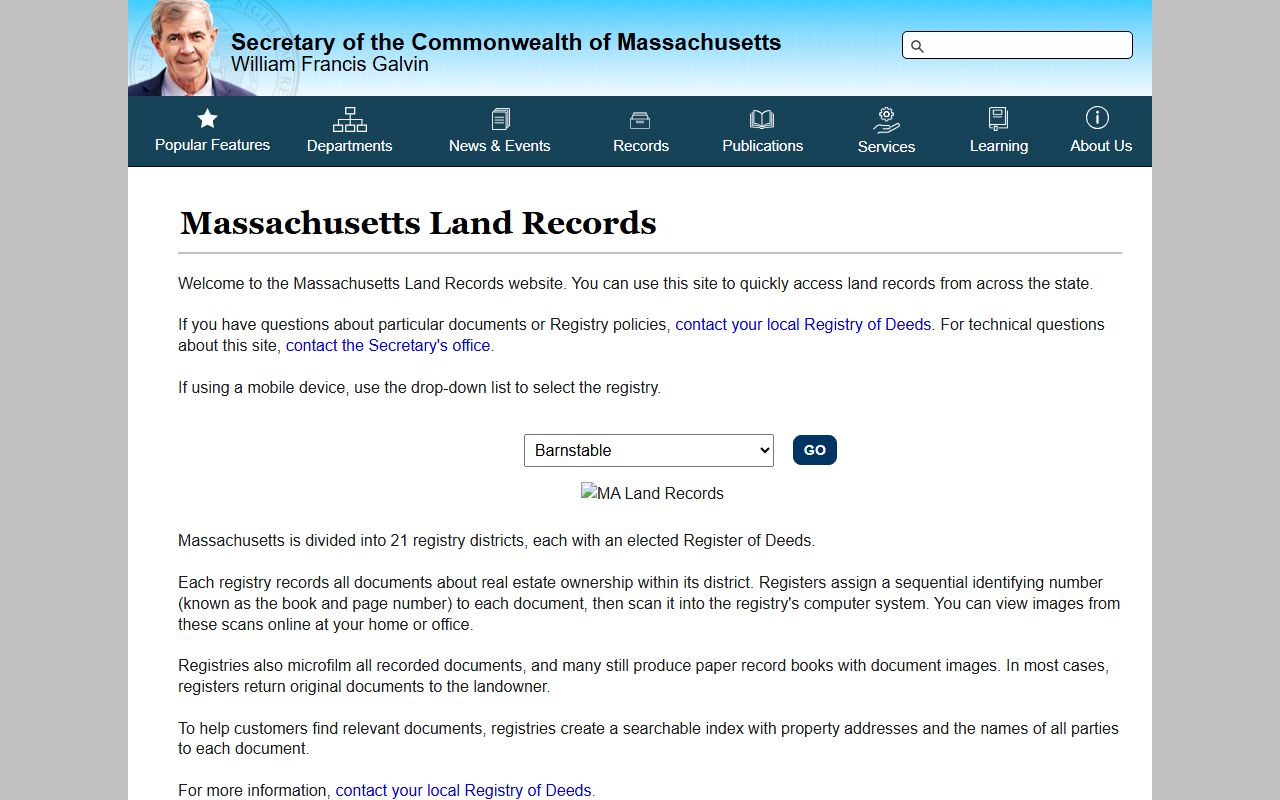
From the portal, select the North, Middle, or South Berkshire district to search the records for the towns in that part of the county.
Historical Deed Records and Genealogy Research
Berkshire County has deed records going back to 1761, which is earlier than many parts of Massachusetts. The three districts each hold their own historical books, and the depth of online access varies by district and time period. The North district has images from 1761 to 1925 and index entries from 1761 to 1985. The Middle district has land records from 1761 to 1925 and indexes from 1761 to 1907. The South district has indexed records from pre-1960 and an unindexed search tool going back to 1731. For the oldest documents, you may need to visit the office in person or contact them to request copies.
For genealogy work, Berkshire County deed records can help you trace property ownership across generations, find family names tied to land grants, and identify relatives who sold or inherited property. The FamilySearch wiki at familysearch.org has a guide to Berkshire County genealogy resources that covers deed records, probate, vital records, and other sources. That page is a good starting point if you are doing research on families who lived in this part of western Massachusetts going back to the colonial period.
Colonial records at the North district include proprietary plans and other documents from the earliest years of settlement in the northern Berkshire towns. These records are not common at most county registries, and they can be valuable if your research goes back that far. Contact the Adams office for details on how to access them.
Note: Older deed records that have not been digitized may require a written request or an in-person visit; turnaround times for copy requests vary by district and volume of requests.
The Consumer Notification Service at cns.masslandrecords.com lets Berkshire County property owners get free email alerts when documents are recorded in their name at any of the three Registry districts.
Signing up takes just a few minutes and gives you an automatic notice any time a deed, mortgage, discharge, or other land document records under your name in Berkshire County.
Nearby Counties
These counties border Berkshire County. If a property sits near a county line, or if your research crosses into a neighboring area, check those registries as well.