
Franklin County Deed Records
Franklin County deed records are kept at the Registry of Deeds in Greenfield, serving all 26 rural towns in western Massachusetts. The registry sits inside the Franklin County Justice Center on Hope Street, and you can search deed records online through the state land records portal at masslandrecords.com or visit the office directly during business hours. This page covers how to find and access Franklin County deed records, what to expect at the office, and what you need to know before you file or request a copy.
Franklin County Overview
Franklin County Registry of Deeds
The Franklin County Registry of Deeds is located at 43 Hope Street in Greenfield, inside the Franklin County Justice Center. The mailing address is different from the physical one: send mail to 425 Main Street, PO Box 1495, Greenfield, MA 01302. You can reach the office by phone at (413) 772-0239 or by fax at (413) 774-7150. Email goes to franklinrod@sec.state.ma.us. The full registry website is at franklindeeds.com.
Recording hours run Monday through Friday from 8:30 AM to 4:15 PM. The office stays open a bit longer for general visits, from 8:30 AM to 4:30 PM. Staff are available to assist during those hours, and the office has public access terminals where you can search records on-site. Franklin County is a rural county, so the registry operates with a smaller footprint than urban registries, but the staff can help you find what you need. If you plan to record a document, arrive before 4:15 PM. Documents brought in after that cutoff will not be accepted for same-day recording.
| Registry | Franklin County Registry of Deeds |
|---|---|
| Physical Address |
43 Hope Street Greenfield, MA 01301 |
| Mailing Address |
425 Main Street, PO Box 1495 Greenfield, MA 01302 |
| Phone | (413) 772-0239 |
| Fax | (413) 774-7150 |
| franklinrod@sec.state.ma.us | |
| Recording Hours | Monday through Friday, 8:30 AM to 4:15 PM |
| Office Hours | Monday through Friday, 8:30 AM to 4:30 PM |
| Website | franklindeeds.com |
The registry website was built on a basic platform with limited online resources beyond what you get through the state portal. For questions not answered online, calling or emailing the office directly is the best approach. Staff are generally responsive and can guide you through local procedures.
Note: This office is inside the Justice Center, not a standalone building. Check signage when you arrive at the Hope Street address.
How to Search Franklin County Deed Records
The main way to search Franklin County deed records online is through masslandrecords.com. On that site, use the dropdown to select Franklin County. You can search by grantor, grantee, document type, or date range. The portal is free and does not need an account for basic searches. When you find a record, you can view the scanned image and save or print it. Certified copies are not available online and must come from the registry office in Greenfield.
The state portal covers recorded documents going back many years. For most title research and property lookups, it handles what you need. That said, some historical records in Franklin County may not be fully digitized or name-searchable for older time periods. If you are doing a deep title search or need documents from a long time ago, an in-person visit or a request to the office may be necessary. The registry also has a FAQ page at franklindeeds.com/faq that addresses common questions about searches, copies, and document types.
Franklin County's registry has limited in-house online tools compared to some larger counties. Most searches beyond the state portal require either a phone call or a visit. Public terminals at the office give you the same access as the state portal, plus staff can help if you are not sure what you are looking for.
The Franklin County Registry of Deeds website at franklindeeds.com is the starting point for learning about local recording procedures, fees, and office details specific to this rural western Massachusetts county.
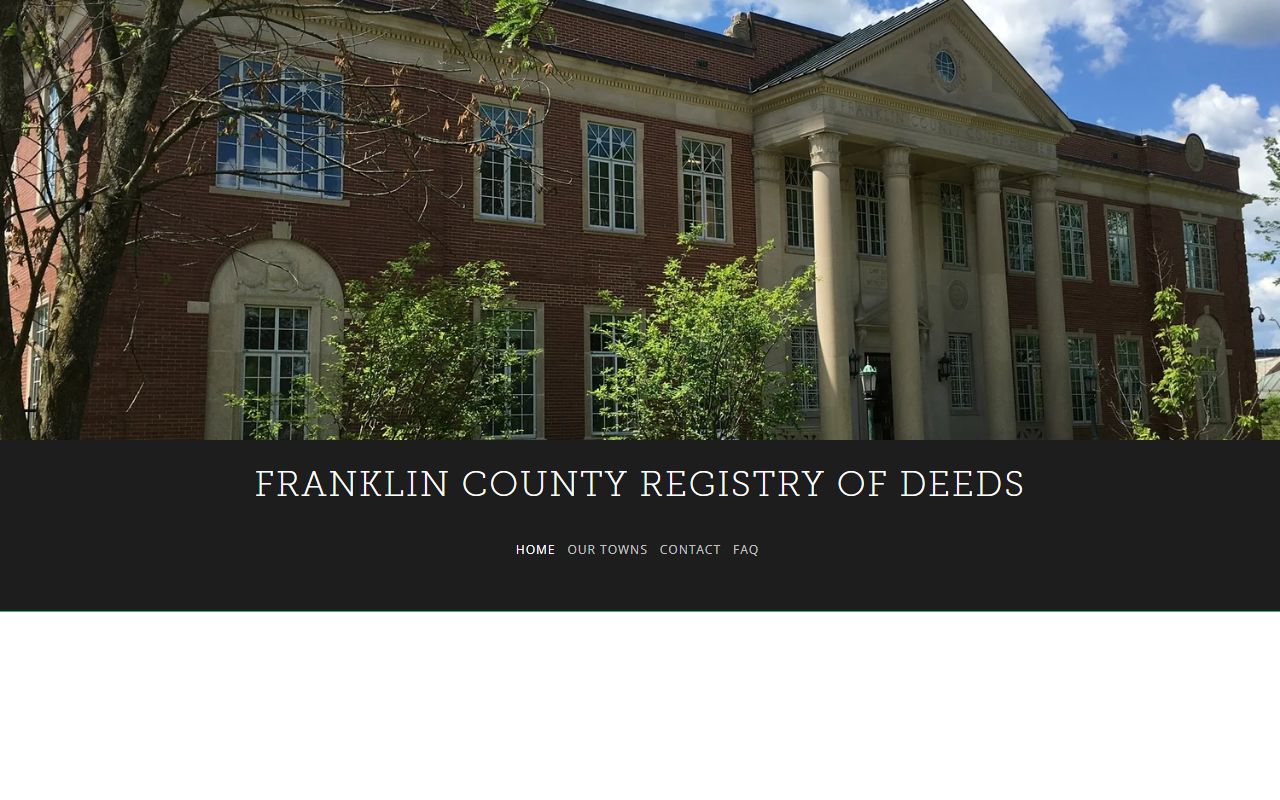
The site links out to the state search portal and provides access to the free excise tax calculator, which is one of the more useful tools the registry makes available to the public.
Getting to the Franklin County Registry
The registry is inside the Franklin County Justice Center at 43 Hope Street in Greenfield. Getting there by car is the most practical option. Franklin County is rural, and public transportation to this office is limited. Plan your route in advance and verify hours before you leave, especially if you are coming from far away.
If you are coming from the east or south, take the Massachusetts Turnpike (I-90) to Exit 4, then follow I-91 North to Exit 26 toward Route 2A in the direction of Greenfield. Enter the rotary and take the first exit onto MA-2A East. Continue through three traffic lights. After the third light, with the Garden Theater on your right, turn right onto Hope Street. The Justice Center will be on your left.
From the north, take Interstate 91 South to Exit 26. Enter the rotary and take the third exit onto MA-2A East. Follow through three traffic lights, then turn right onto Hope Street. The process from there is the same. Allow yourself extra travel time if you are driving from another part of the state. Western Massachusetts roads can be slow, and parking near the Justice Center can be limited during busy periods.
Towns Covered by the Franklin County Registry
The Franklin County Registry of Deeds covers all 26 towns in the county. Every deed, mortgage, discharge, or other land document for any of these towns must be recorded here. There is no city in Franklin County that qualifies for a separate city-level page on this site. All deed records for every address in Franklin County go through the Greenfield registry office.
The 26 towns served are: Ashfield, Bernardston, Buckland, Charlemont, Colrain, Conway, Deerfield, Erving, Gill, Greenfield, Hawley, Heath, Leverett, Leyden, Monroe, Montague, New Salem, Northfield, Orange, Rowe, Shelburne, Shutesbury, Sunderland, Warwick, Wendell, and Whately. You can also review the full list on the registry's own towns page at franklindeeds.com/our-towns.
If you are researching a property and are not certain which county it falls in, check the town first. All 26 towns above fall within Franklin County, so any deed for those addresses is held here. Properties near county borders occasionally cause confusion, but the town name alone tells you the right registry.
The contact page at franklindeeds.com/contact-us lists current office hours, phone numbers, and mailing addresses for the Franklin County Registry of Deeds in Greenfield.
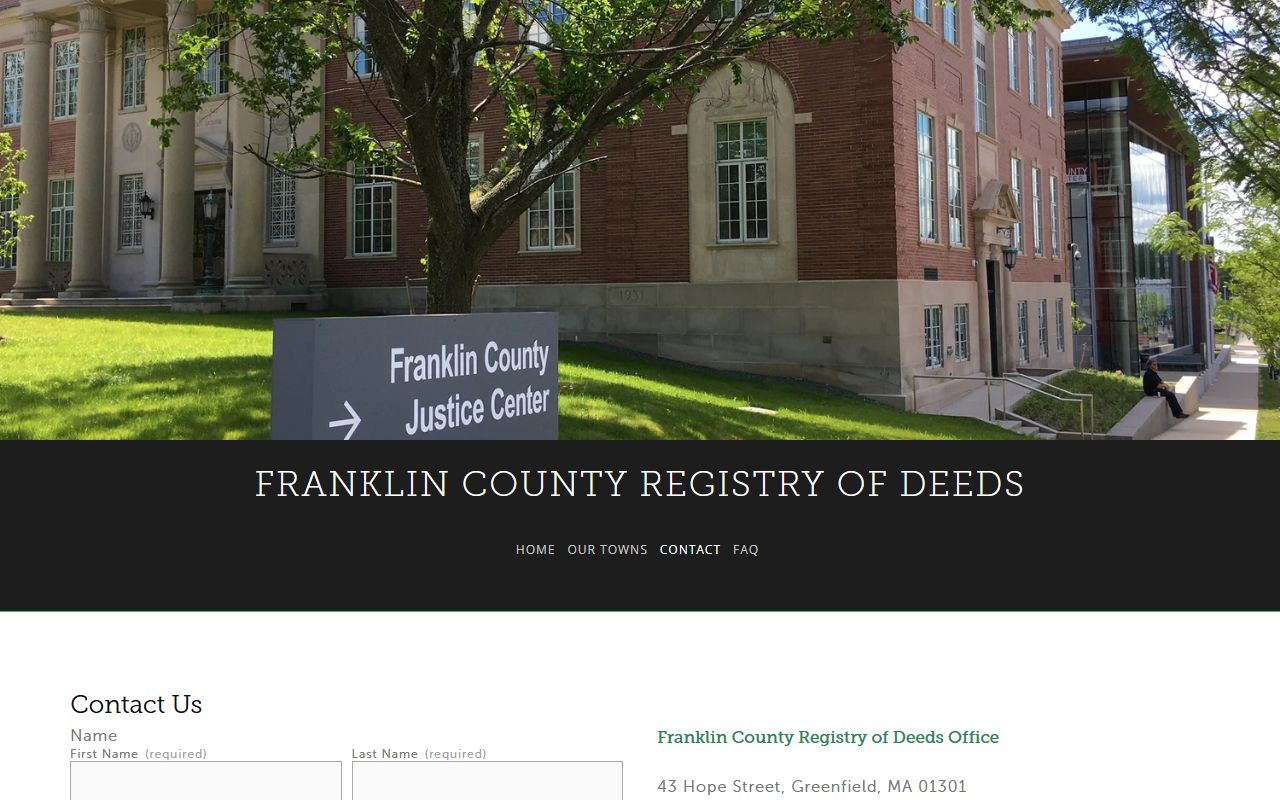
Use the contact page details to confirm hours before you visit or to find the right address when mailing documents or correspondence to the registry.
Franklin County Deed Recording Fees
The Franklin County Registry uses a standard fee schedule. Recording a deed costs $155. A mortgage costs $205 to record. Discharges of mortgage are $105. A homestead declaration runs $35. Plans are $105 per sheet. Copies of recorded documents cost $1 per page. These fees match the state standard and apply to all documents brought to the Greenfield office.
When you record a deed in Massachusetts, you also pay a real estate excise tax at the time of recording. The rate across the state is $4.56 per $1,000 of the sale price. On a $300,000 property, that comes to $1,368 in transfer tax. Franklin County offers a free excise tax calculator at franklindeeds.com/excise-tax-calculator so you can work out the number before you show up at the office. That tool is one of the more practical things the registry makes available online.
Recordings in Massachusetts are governed in part by MGL Chapter 183, which covers conveyances and what a deed must contain to be valid. Documents that are missing required information or signatures may be rejected. Check your documents carefully before bringing them in. The registry staff can tell you what is needed, but they cannot prepare documents for you.
Note: Bring the correct fee amount to the office. Call ahead at (413) 772-0239 to confirm payment methods accepted, as smaller registries may have specific requirements.
In-Person Research at the Greenfield Office
For many Franklin County deed records searches, visiting the Greenfield office in person is the most reliable approach. The registry has public access terminals where you can search the database, view document images, and print copies. Staff are available during office hours to help you understand the system and find specific records. If you are new to deed research or not sure how to trace a chain of title, walking in and asking for guidance is a reasonable first step.
Historical records that are not yet digitized or that fall outside the name-searchable range on the state portal will require in-person or written requests. The office is in a rural county with limited staff, so complex requests may take more time than they would at a larger registry. For title searches going back many decades, give yourself enough time and call ahead to ask whether the records you need are available at the office or held elsewhere.
Bring as much information as you can before you go. A grantor or grantee name, an approximate date range, and a property address or town name will help you find the right documents faster. The more specific your starting point, the less time you will spend searching.
Homestead Protection and Deed Fraud Alerts
Massachusetts homeowners can file a homestead declaration to protect a portion of their home's value from certain creditors. The homestead law is found in MGL Chapter 188. Filing at the Franklin County Registry costs $35 and requires a signed and notarized declaration. Once recorded, the homestead protection attaches to the property. If you own a home in any of the 26 Franklin County towns, the filing goes to the Greenfield registry. It is a simple step that many homeowners overlook.
The state also runs a free Consumer Notification Service at cns.masslandrecords.com. You sign up with your name, and the system sends you an email any time a document is recorded in your name at the registry. For Franklin County property owners, this is a practical way to catch deed fraud or unauthorized transfers early. The service is free and takes only a few minutes to set up. Many people use it for peace of mind after filing a homestead or after hearing about deed-related scams in the news.
Deed fraud is a real concern across Massachusetts. Someone can record a fraudulent document in your name, and without a monitoring service you may not find out for months. The Consumer Notification Service does not block fraud, but it gives you a fast alert so you can take action. Contact the registry at (413) 772-0239 or email franklinrod@sec.state.ma.us if you see a document recorded that you did not authorize.
MGL Chapter 36 also governs the registry itself, covering how records are kept and how the register operates. And the broader Massachusetts General Laws page is the right place to look up the text of any statute that comes up during your research. Both Chapter 183 and Chapter 188 are available there in full.
Nearby Counties
Franklin County borders several other Massachusetts counties. If a property is near a county line, or if your research covers multiple towns in different counties, check these registries as well.